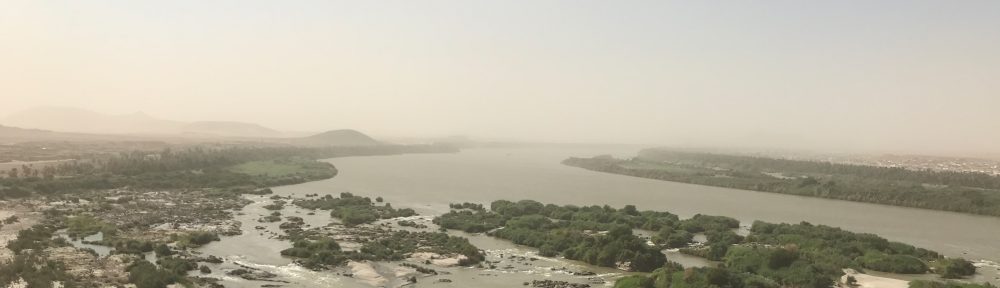
On the occasion of the publication of the latest issue of the Aegyptiaca journal (no. 9, 2025), I would like to draw attention once again to the current situation in Sudan. This brand-new issue also features my review of William Carruthers‘ splendid book, Flooded Pasts (2022).
For Flooded Pasts, Carruthers did a really thorough review of the archival material produced during the famous UNESCO Nubian campaign. He says it’s clear that the archives we’re talking about are part of a (post)colonial context, where modern Nubian communities and their sites have been ignored in the past. The focus of the archives, archaeological investigations and historical narratives is exclusively on the ancient past, thus giving rise to the necessity of „repeopling Nubia“, the subtitle of the conclusion of the book (pp. 274–283).
One result of the UNESCO campaign in Sudan was the opening of the National Museum in Khartoum on 25 May 1971. Even though its garden had temples from Aksha, Buhen, Semna East and Semna West, the museum and its collection weren’t given World Heritage status (unlike Egypt; check out the reviewed book for more on this, on pp. 239–241). Carruthers (p. 242) rightly puts this in context, pointing out that Sudan at the time was “a state in some degree of turmoil” (p. 242). It’s interesting that on page 241, above the heading “Forgetting Sudan?”, there’s a picture of the Sudan National Museum (Carruthers‘ Fig. 7.1). As with so much of Sudan’s cultural heritage, the museum has suffered destruction and looting in a ‚forgotten‘ war, which has been going on since 2023.
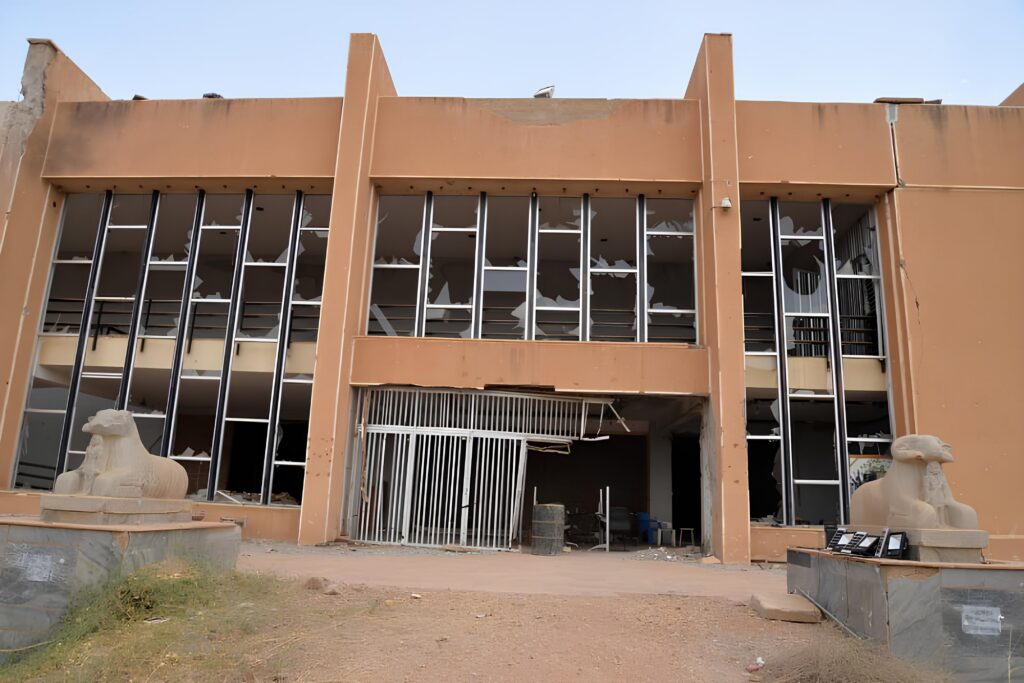
The current conflict in Sudan shows just how closely linked archaeology is to the society around it. The archaeology of Sudan is closely tied to the history of colonialism, and it’s been affected by different forms of exploitation and manipulation by governments and powerful groups who have used it to push their own national agendas. It’s clear that this is just as true today as it was in the past.
At the time of writing, Carruthers said that discussing the future of the Nubians was a tricky topic (p. 283). The war in Sudan has been going on since 2023 and has affected millions of people all over the country. This also shows why we should be interested in creating Nubian histories. It’s not just the institutions involved in the so-called Nubian campaign or archaeologists working in Sudan who should be interested, but everyone on a global level. There are new versions about the Nubian presence in Egypt, Sudan, the United States and other places that are still to be written! And these are anything but marginal.
As we said a few weeks ago at the UNESCO conference in Berlin, we’re never going to give up on Sudan! But we also need more people to talk about Sudan, to care about the Sudanese people and to help protect their rich cultural heritage.
With the festive season here in Europe and another awful war going on just next door, we should remember that millions of Sudanese people have lost everything and are struggling to survive. Sudan is the biggest humanitarian crisis of 2025, and we’re really hoping things will change in 2026.