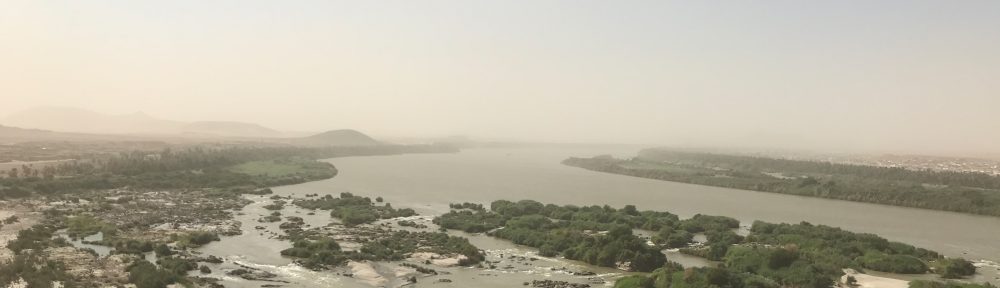
Assessing cultural diversity in the Attab to Ferka region by means of pottery technology

Time passes by for everyone. Also, and above all for archaeologists. Still, it is pleasant when this comes with experience and new opportunities.

On February 2013 I wrote my first post for the AcrossBorders blog. At that time, I was sitting in the magazine rooms of the Sai Island excavation house starting to get familiar with the Nubian fabrics of the New Kingdom town. A few months later I moved to Vienna to join the ERC Starting Grant ‘AcrossBorders’ project led by Julia Budka.

Since then, hundreds of ceramic samples have passed through my hands. These were both Nubian-style and Egyptian-style vessels locally produced at Sai Island / Upper Nubia, but also Imported Nile clays, Marl clays and Oasis clays from Egypt, together with other imported wares from Levant. These materials constituted the aim of my research for AcrossBorders and were sampled, documented and analysed by me together with Johannes Sterba, at the Atominstitut of Vienna. Over the years, thanks to Julia Budka, I have learned how to recognize and classify these wares and fabrics and we calibrated together on them the different analytical strategies and research objectives. Now I fairly know each of those samples by heart.

Yet, we do not grow where things are easy, we grow when we face challenges (and new opportunities).

With October, I happily started in Munich a new three-year contract within Julia Budka’s ERC Consolidator Grant project ‘Diverse Nile’, where I am, together with other researchers and Julia Budka, responsible for the Work Package 3: Reconstructing cultural encounters based on the material culture. My main tasks within WP 3 include petrographic technological and compositional analyses on the ceramic materials sampled from the new concession area in the Attab to Ferka region, dating to the Bronze Age.

Emphasis will lay on pottery technology and mostly on the so-called hybrid products and their significance for cultural encounters (see, e.g., Stockhammer 2013; Matić 2017; Beck 2018; Steel 2018; Souza 2020), on Nubian local style vessels and on the provenience of wheel-made ‘Egyptian’ pottery.

Analytical methods will comprise petrographic (OM) and provenance chemical analysis (iNAA and possibly XRF) but also digital image analysis (DIA) and scanning electron microscopy (SEM) on selected samples. Further, since the focus will lay mainly on pottery technology and manufacturing techniques, other analytical methodologies (e.g., radiography and computed tomography, CT) will be evaluated for studying the internal structures of the objects and the diversity among specific hand -made (i.e., coiling, mold-building, slab-building), wheel-made and possibly also mixed hand-made and wheel-made forming techniques (see e.g., Sanger 2016). A greater importance will be given to observe the technology of production of the vessels aimed at outlining all stages of the manufacturing processes, from raw material procurement through preparation, production, finishing, until use, and discard.
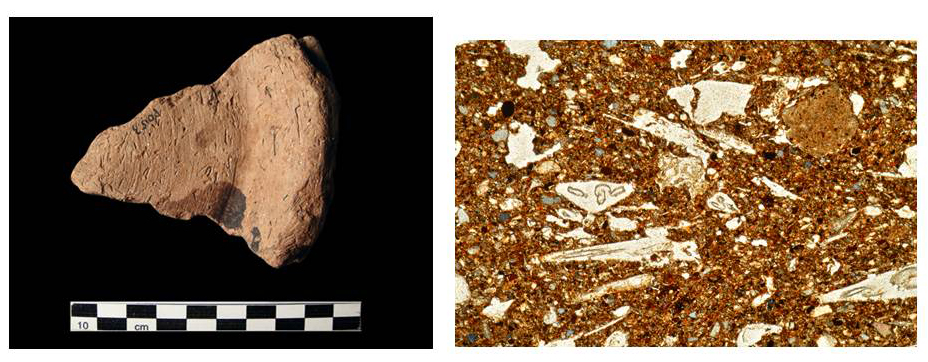
Macro and micro (PPL, 4x magnification) photos of a bread plate sample (manufactured in a local Egyptian-style Nile clay) from SAV 1 East, Sai Island. Note the very fine-grained fabric with abundant organic inclusions distributed randomly through the sample because of the hand-shaped manufacturing (technique).

From a theoretical perspective, a new challenge will be to deal with the ceramic assemblages from the periphery of the central urban sites and relate them to our reference collection from Sai Island. Were there any different strategies in the selection of raw materials, preparation of the vessels and manufacturing techniques between central and peripheral sites? Furthermore, were the proportions between local Nubian-style, Egyptian-style, and various imported vessels equal or not between core sites and periphery?

For this purpose, comparative material from other main New Kingdom/Kerma central sites in Upper Nubia will be incorporated to our principal reference collection from Sai Island.

Luckily, Covid times have not completely blocked us, and thanks to a kind agreement with our colleague and friend Philippe Ruffieux, we are currently waiting to welcome in Munich a bunch of approx. forty samples, among which typical Nubian (Kerma) and Egyptian Nile clay wares from the New Kingdom/Kerma-Dukki Gel site.

It will be a pleasure to start my new task within the DiverseNile project by documenting, sampling, and examining this highly relevant material!

References

Beck, T. 2018. Postkoloniale Objektepistemologien? Homi Bhabhas Konzepte in archäologischen Forschungen – ein Überblick, 237–262, in: M. Hilgert, H. Simon and K.P. Hofmann (eds.), Objektepistemologien. Zur Vermessung eines transdisziplinären Forschungsraums. Berlin.

Matić, U. 2017. Der dritte Raum, Hybridität und das Niltal: das epistemologische Potenzial der postkolonialen Theorie in der Ägyptologie, 93‒111, in: S. Beck, B. Backes and A. Verbovsek (eds.), Interkulturalität: Kontakt ‒ Konflikt ‒ Konzeptualisierung. Beiträge des sechsten Berliner Arbeitskreises Junge Aegyptologie (BAJA 6), 13.11.-15.11.2015. Wiesbaden.

Sanger, M.C. 2016. Investigating pottery vessel manufacturing techniques using radiographic imaging and computed tomography: Studies from the Late Archaic American Southeast, Journal of Archaeological Science: Reports 9, 586‒598.

Steel, L. 2018. Egyptianizing practices and cultural hybridity in the Southern Levant during the Late Bronze Age, Journal of Ancient Egyptian Interconnections 20, 15‒30.

Stockhammer, P.W. 2013. From Hybridity to Entanglement, from Essentialism to Practice, Archaeological Review from Cambridge Issue 28.1: Archaeology and Cultural Mixing, 11‒28.

Souza, A. M. de. 2010. Melting Pots: Entanglement, Appropriation, Hybridity, and Assertive Objects between the Pan-Grave and Egyptian Ceramic Traditions, Journal of Ancient Egyptian Interconnections 27, 1‒23.
Mortuary archaeology in the area from Attab to Ferka (MUAFS concession area)

With my appointment as the newest member of the DiverseNile team, it’s now time to present Work Package 2: The Variability of Funerary Monuments in the Region from Attab to Ferka, Northern Sudan.

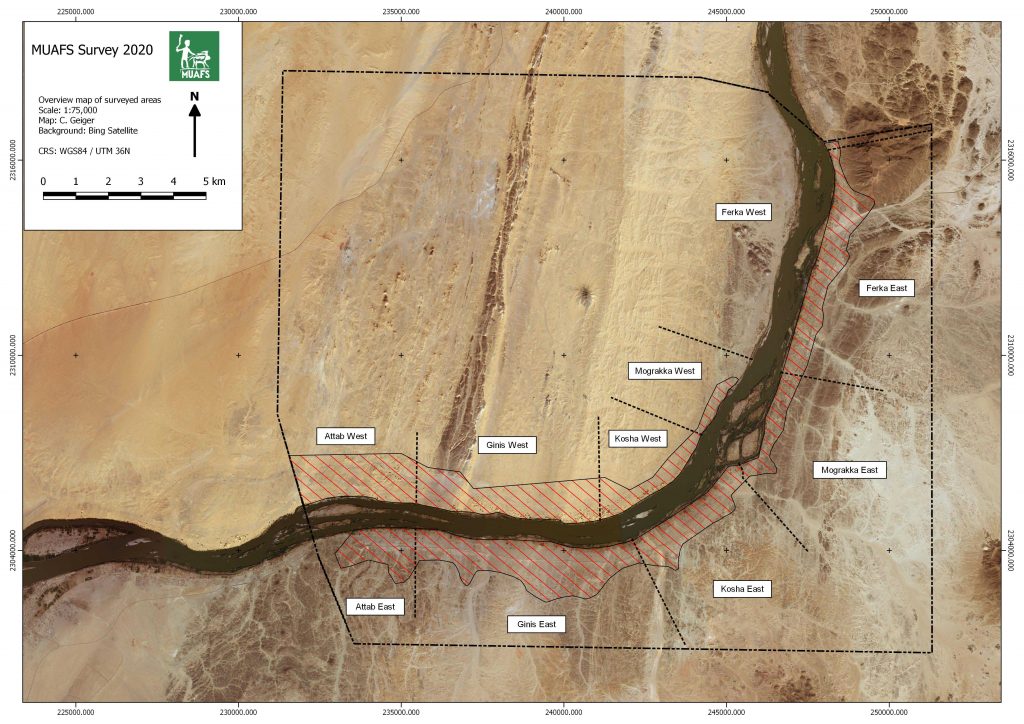
Figure 1: Map of MUAFS concession with overview of surveyed areas (C. Geiger).

As responsible for Work Package 2, I will investigate, with PI Julia Budka, all aspects of mortuary sites within the MUAFS concession area (figure 1). The area from Attab to Ferka was firstly surveyed by André Vila within a larger survey from Dal to Missiminia. The results of Vila’s survey were published by the French CNRS in 15 volumes, which describe numerous sites located in the area­­­­­. Volumes 3 to 6 focus on the MUAFS concession in the region from Attab to Ferka.

Vila identified a series of funerary sites between Attab and Ferka, which I will explore in my research within the DiverseNile team. The aim is to understand the materialisation of cultural diversity through tomb architecture, burial customs and goods, focusing on the Bronze Age, which in our concession area comprises the Kerma, Egyptian New Kingdom and Napatan periods.

The 2018/19 and 2020 seasons of MUAFS survey re-identified and documented various burials sites previously listed by Vila, some of which were extensively plundered in recent times (Budka 2019; see also our online reports). Two cemeteries at Ginis East seem to be especially relevant for future excavation. GiE002 (Vila site 2-T-13) and GiE003 (Vila site 2-T-13) date to the Kerma Period and Egyptian New Kingdom, respectively. Kerma cemeteries usually comprise tumuli burials, while New Kingdom sites include shaft tombs with no preserved superstructure. Magnetometry was carried out at both sites in 2019 and will be used to further assess the archaeological potential of the cemeteries to plan future excavations. An additional survey is also planned for the next season, which will hopefully reveal more potentially relevant cemeteries or isolated tombs.

Besides new excavations, a large part of research on mortuary sites in our concession area consists of revisiting publications, archives and material culture previously excavated and now in museums. I’m currently developing a research strategy that will explore both avenues. My PhD experience demonstrated the huge potential of revisiting old excavation reports and archival material (see, for example, Edwards 2020), as well as museum collections from a fresh theoretical perspective.

In general, the DiverseNile project focuses on shifting conceptualisations and experiences of ‘centres’ and ‘peripheries’. My previous research stresses the contextual role performed by foreign objects in local contexts in New Kingdom cemeteries in Nubia. I argue that foreign, Egyptian-style objects could perform alternative, local tasks other than materialising Egyptian colonisation through objects in Nubian contexts (Lemos 2020). DiverseNile Work Package 2 will combine both general theoretical perspectives to unveil cultural diversity in contexts previously thought to express homogenisation only.

I am also particularly interested in refining our understanding of New Kingdom chronology in Nubia. So far, Egyptocentric approaches have mainly accepted that the same dates used to understand Egyptian history apply to Nubian colonial contexts. In my PhD thesis, I discuss the use of alternative terminology, based on local Nubian experiences of colonisation, instead of landmarks of Egyptian political history. DiverseNile has been adopting ‘Bronze Age Nubia’ as a working alternative. PI Julia Budka and I will be closely working on this topic, and I hope that new excavations will provide us with more refined dates than those usually extracted from typological approaches to sites and material culture. This would be especially relevant for the end of the New Kingdom colonial period/pre-Napatan Period, which is still poorly understood (e.g., Thill 2007; Binder 2011).

Stay tuned to this space for updates regarding my work on mortuary sites and material culture in Attab-Ferka!

References

Binder, M. 2011. The 10th-9th century BC – New Evidence from Cemetery C of Amara West. Sudan & Nubia 15: 39-53.

Budka, J. 2019 (with contributions by G. D’Ercole, C. Geiger, V. Hinterhuber and M. Scheiblecker). Towards Middle Nile Biographies: the Munich University Attab to Ferka Survey Project 2018/2019. Sudan & Nubia 23: 13-26.

Edwards, D. ed. 2020. The Archaeological Survey of Sudanese Nubia, 1963-1969. The Pharaonic Sites. Oxford: Archaeopress.

Lemos, R. 2020. Material Culture and Colonization in Ancient Nubia: Evidence from the New Kingdom Cemeteries. In Encyclopedia of Global Archaeology, ed. C. Smith. New York: Springer. https://doi.org/10.1007/978-3-319-51726-1_3307-1

Thill, F. 2007. Les réoccupations “(pré)napatéennes” dans le cimetière égyptien 8B5/SAC5 de Sai. In Mélanges offerts à Francis Geus, ed. B. Gratien. CRIPEL 26: 353–369.

New recruitment: proud to introduce Rennan Lemos

Good things come to those who wait – this holds especially true in the times of the corona pandemic. I am more than delighted and very grateful to all who made it possible despite of the crisis that finally, after a very long wait since March, I can now welcome Rennan Lemos from Brazil as a new team member for the ERC DiverseNile project! Welcome to Munich, dear Rennan!

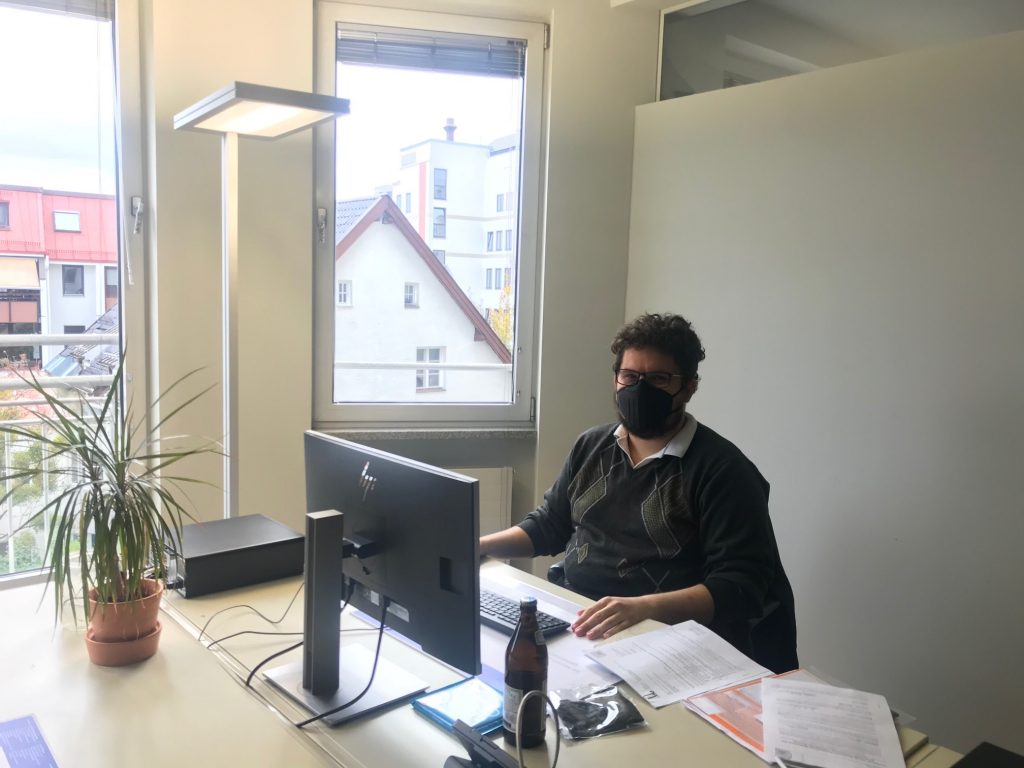
Rennan’s first day in office here in Munich.

Rennan was the successful candidate in a call for applications earlier this year – we had very strong candidates from all over the world, but he convinced us in the end, especially because of his PhD thesis which fits perfectly to the objectives of DiverseNile.

Early in 2020, Rennan has handed in his thesis, entitled Foreign Objects in Local Contexts: Mortuary Objectscapes in Late Colonial Nubia, under the supervision of Dr Kate Spence at the Department of Archaeology at the University of Cambridge.

He is a trained specialist in Egyptian and Nubian material culture, with extensive experience excavating, handling, documenting and publishing ancient objects. In his career, he has focused on the study of elite and non-elite mortuary contexts in Egypt and Sudan, usually associated with theoretical perspectives in favour of social complexity and cultural diversity.

Rennan’s PhD thesis deals with the problem of the spread of Egyptian-style material culture in mortuary contexts in New Kingdom Nubia. His work offers a more complex perspective on the role of foreign objects in mortuary contexts in Nubia beyond previous homogenising approaches based on the concept of Egyptianisation, but it also presents a critique to approaches excessively focused on cultural contacts, such as cultural entanglement. His interpretation of material from various cemeteries in Sudan is conducted in the light of state-of-the-art theoretical discussions in Material Culture Studies, Postcolonial Theory and Sudanese Archaeology.

All of this and especially his deep knowledge of mortuary material culture and contexts in Nubia made Rennan the perfect choice for us: He is now the responsible person for Work Package 2 (The Variability of Funerary Monuments in the Region from Attab to Ferka), aiming to illustrate the cultural diversity on the religious level by disentangling burial grounds from previous cultural categorisations and showing acceptance, appropriation or ignorance of various cultural influences in the funerary sphere.

Looking much forward to this new collaboration with our fresh team member!

Once upon a time… in Nubia, Egypt and Vienna

October has passed really fast, with increasing attention given to the covid-19 crisis. The latter will of course continue in the next weeks…

The DiverseNile project has got some reinforcement in the person of Giulia D’Ercole. Building upon her expertise gained in the framework of the AcrossBorders project, she will be focusing within our Work Package 3 (material culture) on various assessments and analyses of ceramics from the MUAFS concession. A special focus will be on the question of ‘peripheral’ Kerma pottery production including a comparison with the one at the capital, at Kerma city.

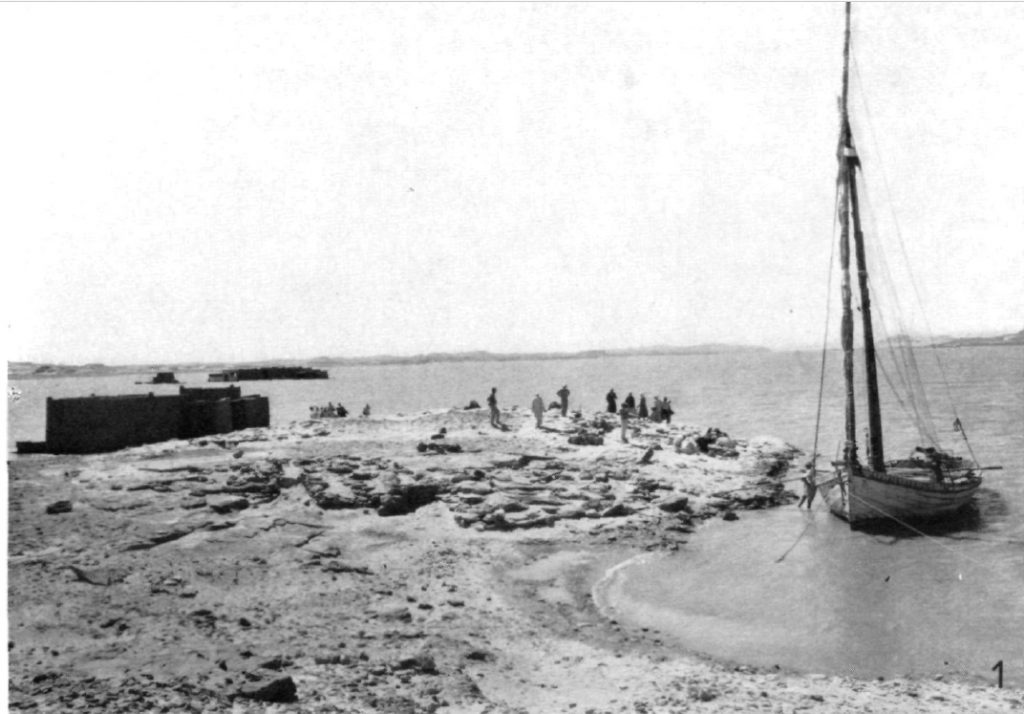
Also in other respects, October was very busy – and somehow sentimental, full of memories – nice ones fortunately! Earlier this month, one of the most remarkable present-day Austrian Egyptologists celebrated a round-numbered birthday – my PhD supervisor Manfred Bietak is well-known for his research and publication activities on Egyptian archeology and especially on cultural contacts during the Middle Bronze Age in the eastern Mediterranean. Very remarkable, but little-known is also his field work in Nubia early in his career – as a member of the excavations by the Austrian National Committee of the UNESCO Campaign for the Rescue of the Nubian Antiquities in the Sayala district, he excavated between 1961-1965 various cemeteries of Nubian groups (especially so-called C-Group and Pan-Grave, but also later tombs potentially associated with Blemmyes), as well as relics of the Medieval period. This early experience left a deep impression and all of his students know stories by Manfred being told at excavations and excursions starting with “once upon in Nubia, …”. I consider myself fortunate to be among these students and am simply grateful for such an inspiring teacher!

Once upon in Nubia – here in Sayala, 1965. Bietak and Jungwirth 1966, pl. 1.

To celebrate Manfred’s birthday but also his achievements for the study of Late Period Egypt, I organized the first online Study Day of the Ankh-Hor project. This day was a real success and the lectures are by now available online via LMU cast.
Finally, a podcast has been released where I immerse myself in my memories – talking about the critical moment in my career when it was unclear whether I can stay in academia or not.

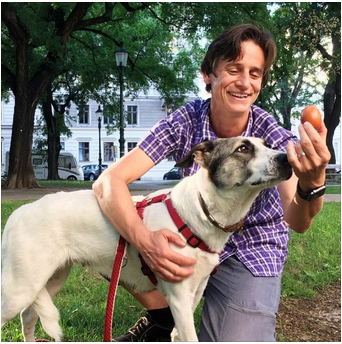
https://scilog.fwf.ac.at/podcasts/die-archaeologin-im-hundepark

If you want to know what an egg and my dog’s interest in this egg has to do with that – then you will have to listen to the podcast 😉!

Reference:

Bietak, M. and Jungwirth, J. Die österreichischen Grabungen in Ägyptisch-Nubien im Herbst 1965, in: Ann. Naturhistorisches Museum 69, 1966, 463-470.