Next DiverseNile Seminar: Napatan Funerary Amulets

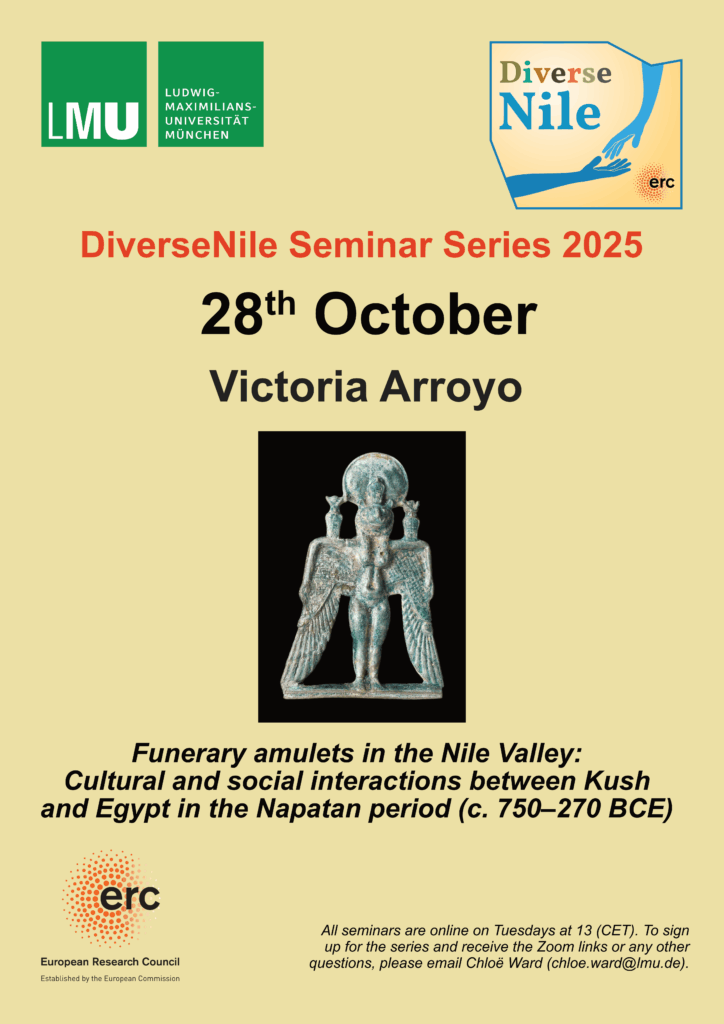
I am delighted to announce the upcoming DiverseNile seminar!

Our next speaker is Victoria Arroyo, a PhD candidate in Egyptology at the University of Münster, who has received a scholarship from the DAAD (German Academic Exchange Service).

She will be talking about her PhD thesis and the title of her lecture is: ‚Funerary Amulets in the Nile Valley‘. Cultural and Social Interactions Between Kush and Egypt in the Napatan period (c. 750–270 BCE).

I’m really looking forward to this, which promises to offer an updated perspective on the use of funerary amulets during the Napatan era.

Museums, antiquities, heritage, and the ongoing war in Sudan II

After a long silence, the Sudanese antiquities and heritage, which have been ravaged by destruction, looting, and theft, are celebrating the Ministry of Culture and Information’s approval of international laws and conventions related to the protection of Sudanese heritage from looting, wars, and theft. This news is a beacon of hope that will push forward the protection of heritage in Sudan. The efforts of the state to protect the heritage in Sudan, represented by the antiquities stolen during the war in Khartoum between the Sudanese army and the Rapid Support Forces, are notable. There are several promising signs that this agreement will bring if the state is keen to swiftly implement it.

In this context, I will discuss some aspects related to these agreements, hoping that the international community will provide all possible support. I will review with you some aspects and questions related to the importance of these agreements for Sudan’s antiquities and heritage.

Firstly, what is the benefit of the Cultural Property Convention? And what is the 1995 UNIDROIT Convention on Stolen or Illegally Exported Cultural Objects? The 1995 UNIDROIT Convention aims to protect cultural heritage by establishing general legal rules for the return of stolen or illegally exported cultural objects. The importance of this convention lies in:

– Protecting cultural heritage: It contributes to protecting cultural property from theft and smuggling and promotes international cooperation for its recovery.

– Facilitating the return of cultural property: It provides a legal mechanism for the return of stolen or illegally exported cultural objects, making it easier for countries to recover their cultural heritage.

– Enhancing international cooperation: It encourages cooperation between countries to strengthen the protection of cultural heritage and combat illicit trafficking in cultural property.

– Protecting cultural identity: It contributes to protecting the cultural identity of countries and communities and promoting a sense of belonging and pride in cultural heritage.

– Combating illicit trafficking: It contributes to combating illicit trafficking in cultural property and promoting transparency and accountability in the trade of antiquities and cultural objects.

In general, the 1995 UNIDROIT Convention aims to strengthen the protection of cultural heritage and the return of stolen or illegally exported cultural objects, and to promote international cooperation in this field.

Secondly, what are the consequences of delaying the implementation of these conventions, especially for the collections of the National Museum? Delaying the implementation of international conventions for the protection of antiquities and heritage in Sudan and the National Museum can lead to several negative consequences, including:

– Increased looting and theft: Delaying the necessary measures to protect antiquities and heritage can increase the chances of looting and theft of museums and archaeological sites, as happened in the National Museum in Khartoum, where many rare artifacts were looted and stolen.

– Destruction of cultural heritage: Delaying the protection of antiquities and heritage can lead to their complete destruction, especially in the context of armed conflicts and wars, where archaeological sites and museums are subjected to bombardment and destruction.

– Loss of cultural identity: Cultural heritage plays a significant role in defining the identity of peoples, and losing it can lead to a national identity crisis.

– Difficulty in recovering stolen artifacts: The longer the delay between the theft of artifacts and the necessary measures to recover them, the more difficult it becomes to recover them, especially if they are sold on the global market or smuggled out of the country.

– Impact on scientific research: Losing cultural heritage and antiquities can make it difficult to conduct scientific research and archaeological studies, affecting our understanding of Sudanese history and culture.

– Negative impact on tourism: Cultural heritage and antiquities play a significant role in attracting tourists, and losing or destroying them can negatively impact the tourism sector in Sudan.

Examples of destruction include:

– The National Museum in Khartoum: It was looted and raided, and trucks loaded with artifacts left the museum, resulting in the loss of important artifacts.

– Nyala Museum: All the properties and museum collections were looted.

– The Khalifa Abdallah Museum: It was looted and parts of the building were destroyed.

– The Naga’a and Musawwarat area: It was attacked by the Rapid Support Forces, and videos were filmed inside the archaeological sites.

– Jebel Barkal: A World Heritage site that faces significant challenges due to urban and agricultural expansion, which could lead to its removal from the list.

Efforts to protect heritage include:

– The National Corporation for Antiquities and Museums: It works to recover stolen artifacts and track them through Interpol and international security institutions.

– UNESCO: It tries to coordinate efforts to protect Sudanese heritage by enhancing cooperation with local and international organizations.

– Civil society organizations: They play a significant role in highlighting the importance of antiquities and heritage and advocating for their return.

Thirdly, how can international laws and conventions be applied to protect Sudanese heritage, such as what was looted from the National Museum in Khartoum? To protect heritage in Sudan, international laws are applied through several mechanisms:

– UNESCO’s role: UNESCO works to promote the protection of cultural heritage in Sudan, especially after reports of looting and destruction of museums and archaeological sites. The organization has sounded the alarm and expressed deep concern about these actions.

– International cooperation: UNESCO encourages the international community to make joint efforts to protect Sudanese cultural heritage, including preventing the illicit trafficking of antiquities and cultural objects.

– Training and awareness: UNESCO provides training courses to enhance the capabilities of local authorities in the field of cultural heritage protection, in addition to raising public awareness about the importance of preserving heritage.

– Damage assessment: UNESCO works to assess the damage to archaeological sites and heritage in Sudan, including using satellite images to identify affected sites.

– Support for artists and local communities: UNESCO provides support to artists and local communities in Sudan through the establishment of art centers and cultural programs that help pre serve cultural heritage.

Regarding the National Museum in Khartoum as an example, several measures can be taken to protect the looted heritage, including:

– Recovery of stolen artifacts: Working to recover stolen artifacts from the National Museum and other museums in Sudan.

– Preventing illicit trafficking: Working to prevent the illicit trafficking of Sudanese antiquities and cultural objects through cooperation with local and international authorities.

– Documenting damage: Documenting the damage to the National Museum and other archaeological sites in Sudan to present it to the relevant authorities to take necessary measures.

The Ministry of Culture’s approval of international conventions related to the protection of Sudanese heritage is a positive step towards protecting heritage in Sudan, especially in the face of challenges posed by wars and conflicts.
New publication: Perspectives on the post-colonial period in the Attab to Ferka region

Within the DiverseNile project, we focus on developments and dynamics in the Bronze Age, particularly in the Late Bronze Age. The collapse of the Late Bronze Age is also a key consideration here, and I have recently revisited Post New Kingdom evidence from the MUAFS concession.

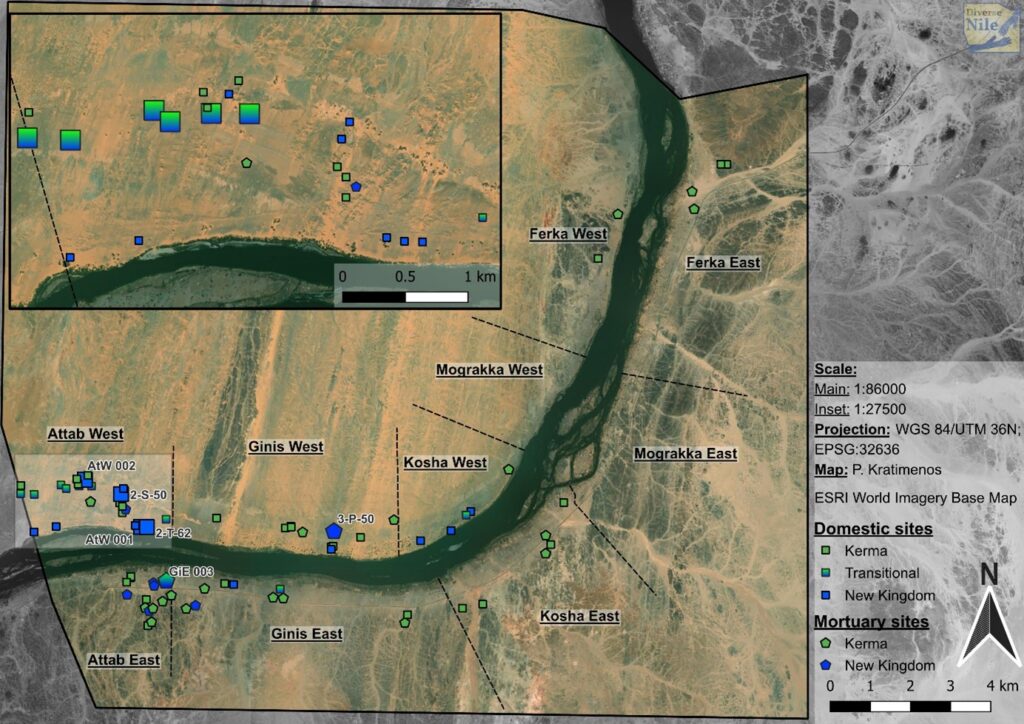
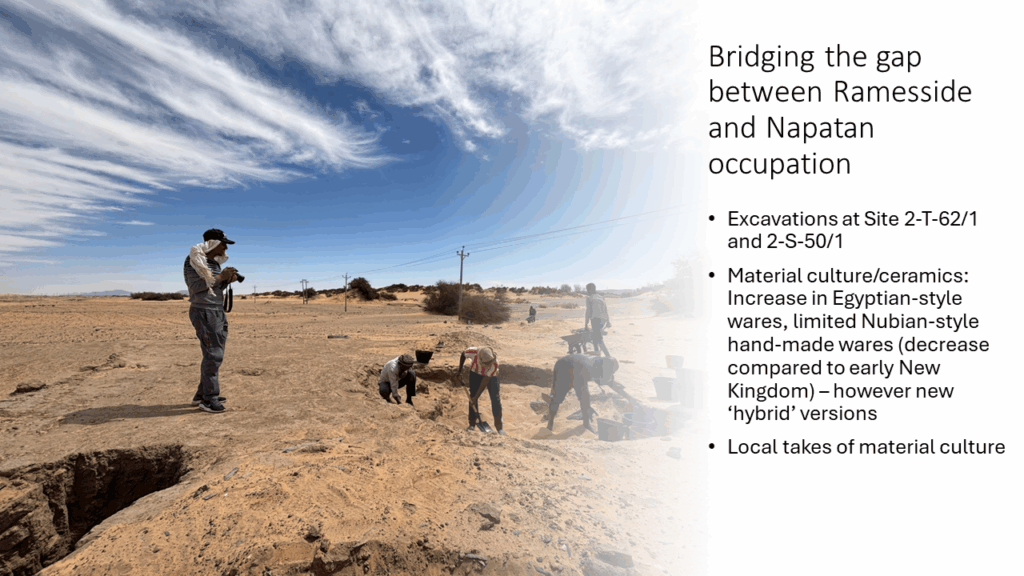
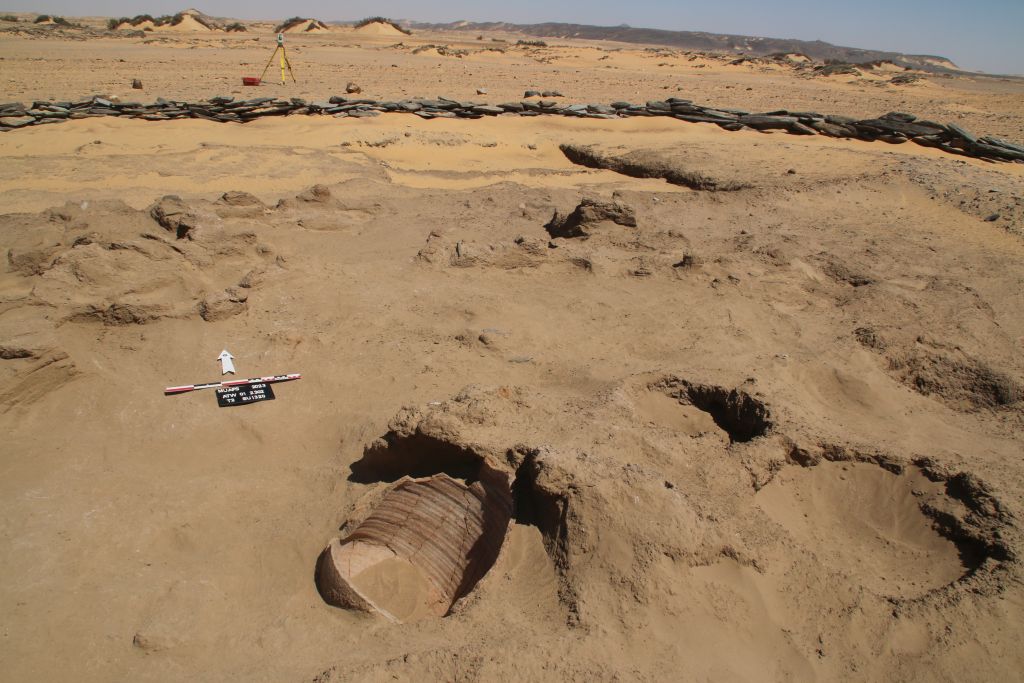
I am delighted that a publication is now available. In this new article (Budka 2025), I have attempted to shed new light on an old topic. In recent decades, the concept of a ‘Dark Age’ in ancient Sudan at the beginning of the first millennium BCE has increasingly been questioned within Nubian archaeology. This is primarily due to new archaeological discoveries at urban sites such as Tombos and Amara West, as well as new theoretical approaches that have emerged since the post-colonial shift. My recently published study aims to demonstrate that remote sensing, surveying and excavations in the Attab to Ferka region of Sudan have also yielded significant evidence of sustained habitation following the termination of Egyptian colonial rule over Nubia. Studies of settlement patterns and pottery, in particular, enrich our understanding of people’s lives between 1070 and 750 BCE, allowing us to shed light on dynamic processes, local forms of resilience and innovation.

This new understanding of the resilience of communities after the collapse of colonial Nubia under Egyptian rule enables a more nuanced interpretation of the development of the Napatan Empire and challenges the conventional concept of secondary states.

The Attab to Ferka case study shows that marginalised regions and communities made a significant contribution to cultural dynamics and achievements in Sudan during the first millennium BCE.

I’m very much looking forward to receiving feedback on this discussion and my theory!

Reference

Budka, J. 2025. The End of the Egyptian New Kingdom in Colonial Nubia: New Perspectives on Sociocultural Transformations in the Middle Nile. Humans. 2025; 5(4):26. https://doi.org/10.3390/humans5040026

Museums, antiquities, heritage, and the ongoing war in Sudan

By Mrs. Huda Magzoub Al-Bashir, Senior Curator of the Sudan National Museum, Khartoum (status: 14th Oct. 2025)

Mechanisms for protecting museums and antiquities in Sudan

The mechanisms for protecting museums and antiquities in Sudan are divided into two parts:

Firstly: The mechanism for protecting the building with its contents. This is further divided into two parts in terms of importance:

1. Archaeological, historical, and heritage buildings, where preservation is more important and requires greater care and caution. This also includes museums and field museums.

2. Museum collections, archaeological, historical, and heritage collections, whose preservation depends on the preservation of the building in which they are displayed, after careful selection of the site, method, and materials of construction, and the importance and concern of the state in doing so.

Secondly: The state’s mechanism for paying attention to museums, antiquities, and heritage, as a symbol of national sovereignty and identity, and any negative interference with it requires swift and necessary response.

Prior planning:

Establishing a museum under state sponsorship requires prior planning to protect it from internal and external threats and to adopt a sound and effective method for preserving it.

Mechanism based on supporting national security awareness to protect antiquities and museums and the right to swift intervention through those in charge of managing museums, antiquities, and heritage in Sudan, by following pre-planned methods to protect archaeological collections in museums and rescue them to safe areas or routes.

Mechanism for preserving museum collections:

This mechanism is the primary work mechanism in this field and is represented by:

– Museum collections themselves, in terms of collecting, restoring, documenting, displaying, publishing, preserving, and making copies of them.

– In this context, when feeling insecure, relying on the experiences of some countries that have previously preserved the originals of collections, antiquities, and artifacts in safe places and displayed copies of them to avoid theft or attacks, even if it requires returning them to the ground or to secret storage until safety is ensured.

Insurance mechanism through security agencies recognized and approved by the state to protect museums, antiquities, and heritage in Sudan.

These security agencies must receive adequate training to qualify them to preserve and protect collections and their locations, including museums.

Armed defense mechanism:

This mechanism is only allowed to be used in case of an attack on museums or their contents. It requires a deadly defense by specialized agencies to do this work and make the security of museum facilities part of national security.

Avoiding exposure of archaeological museums and their heritage to looting:

To avoid exposure of museums with rare archaeological collections to looting, especially in cases of armed threat, requires prior efforts based on:

– The state’s interest in its heritage and collections, whose loss would affect the state’s dignity, strength, and prestige.

– Several aspects and methods can be followed to avoid exposure of museums, antiquities, and museum collections to looting, theft, and aggression:

    1. Increasing and developing insurance and its methods, according to modern techniques of theft, and benefiting from the experiences of other countries.

    2. Addressing and cutting off corruption in all aspects related to the management of museums, antiquities, and heritage in Sudan.

    3. Financial preparedness can play an important role in avoiding exposure of museums to looting, by providing the necessary resources for protection and security.

    4. Working continuously to raise cultural awareness of the importance of museums, especially among security agencies, and instilling a sense of national duty to defend this heritage.

    5. Seeking international cooperation and assistance from organizations concerned with protecting museums, antiquities, and heritage worldwide.

    6. Establishing laws and deterrent penalties that must be put in place in agreement with the state and adopted internationally in case of exposure of museums, antiquities, and national heritage to looting, especially by armed parties.

State efforts to safeguard cultural heritage: The war in Sudan and the protection of antiquities

On Tuesday, October 14, 2025, the Council of Ministers approved a number of international agreements for the Ministry of Culture, Information, and Tourism. This was considered a historic event due to the long wait for these agreements to be reviewed by the Council. The approved agreements include:

1. Convention on the Means of Prohibiting and Preventing the Illicit Import, Export and Transfer of Ownership of Cultural Property (1970).

2. Convention on the Protection of the Underwater Cultural Heritage (2001).

3. UNIDROIT  „Institut international pour l’unification du droit privé“.    Convention on Stolen or Illegally Exported Cultural Objects (1995).

Additionally, the Council approved several memoranda of understanding between the Ministry of Culture, Information, and Tourism and its counterparts in China and Russia, including:

1. Memorandum of Understanding between the Ministry of Culture, Information, and Tourism of Sudan and the Ministry of Culture of the Russian Federation on cooperation in the field of culture.

The Sudan National Museum and the War in Khartoum: A guest contribution by Huda Magzoub Al-Bashir

Presented by: Huda Magzoub Al-Bashir, Head of Antiquities, Sudan National Museum, 09 October, 2025.

The Sudan National Museum in Khartoum has been severely damaged due to the ongoing war in the country. The museum, which houses thousands of artifacts from ancient civilizations, including statues, mummies, and golden relics, was looted and vandalized by armed groups.

Key Facts:

– Location: The museum is situated in Khartoum, the capital city of Sudan, along the Nile River.

– Damage: Many exhibits were stolen, and some were damaged beyond repair.

– Looted Artifacts: The stolen artifacts include golden relics and other valuable items.

– Responsibility: The Sudanese authorities blame the Rapid Support Forces (RSF) for the looting and damage.

– Impact: The looting and destruction of the museum have sparked widespread concern and condemnation, with many calling for the preservation of Sudan’s cultural heritage .

The Sudan National Museum in Khartoum has suffered significant damage and looting due to the ongoing civil war between the Sudanese Armed Forces (SAF) and the paramilitary Rapid Support Forces (RSF). Here are some key points about the situation:

– Destruction and Looting: The museum, which houses an estimated 100,000 objects, has been comprehensively looted, with thousands of artifacts stolen or destroyed. The RSF occupied the museum in June 2023, and videos have shown empty galleries, shattered display cases, and rubble strewn across the institution.

– Cultural Significance: The museum’s collection includes ancient Nubian kingdoms, Kushite empire, Christian kingdoms of Alodia and Makuria, and Islamic sultanates of Sennar and Darfur. Some of the most valuable items stolen include mummies dating back to 2500 BCE and royal Kushite treasures.

– International Response: UNESCO has appealed to international art dealers, museums, and customs authorities to refrain from trading in or facilitating the movement of Sudanese cultural property looted from the museum or protected sites. The international community is urged to raise awareness and share documentation identifying looted Sudanese artifacts to recover them.

– Current State: The museum’s strongroom was breached, and its entire archaeological gold collection was stolen. A large storage space containing over 500,000 artifacts from across the country was also ransacked and damaged.

– Impact on Heritage: Sudanese intellectuals and citizens have expressed profound grief over the museum’s destruction, framing the loss as symbolic of the broader devastation wrought by the war. The war has endangered Sudan’s cultural heritage, with several regional museums and archaeological sites vulnerable to looting and destruction.

The conflict has resulted in tens of thousands of deaths, displaced millions, and plunged the country into a humanitarian crisis. Both the SAF and RSF have been accused of committing human rights violations and international crimes

There is evidence suggesting that the stolen artifacts from the Sudan National Museum have been trafficked to several destinations, including:

– South Sudan: According to Sudanese officials, some of the stolen artifacts have been smuggled into South Sudan, where they are being bought and sold by antiquities dealers. Some of the artifacts have been identified in Juba, the capital of South Sudan, and efforts are underway with Interpol to track them down.

– International markets: Reports have emerged of stolen Sudanese artifacts being offered for sale on online platforms, such as eBay, where three stolen Sudanese statues were listed for sale for $200. However, the listings were later removed.

– Within Sudan: Some of the stolen artifacts have been found hidden in factories and homes within Sudan, as was the case in the city of Atbara, where stolen artifacts from the Nyala Museum in Darfur were discovered.

Efforts are being made by Sudanese authorities and international organizations to recover the stolen artifacts and protect Sudan’s cultural heritage.

Archaeology in the Gezira Reach: Forthcoming DiverseNile Seminar

As the summer season draws to a close, it is also the case that the short hiatus from the DiverseNile Seminar is coming to an end. It is with great pleasure that I announce the forthcoming DiverseNile Seminar, scheduled to take place on 2 September, presented by Mohammed Alfatih Hayati.

Mohammed is currently employed as an Assistant Professor in Archaeology at the Department of Archaeology of the University of Khartoum in Sudan. His particular area of expertise is the Later prehistory (Mesolithic-Neolithic) of Sudan. Mohammed was awarded his PhD in Archaeology from the University of Khartoum in 2016. He is a member of numerous archaeological field projects in Sudan.

The subject of Mohammed’s presentation is „Archaeology in the Gezira Reach. Current State and Future Challenges“. In the context of the ongoing war in Sudan, it is imperative to consider the impact on both the Sudanese people and the nation’s substantial cultural heritage and rich archaeological sites. Current assessments and future challenges pertaining to significant archaeological regions, such as the Gezira, must be addressed in order to formulate effective strategies for the preservation and protection of these invaluable assets.

I’m very grateful to Mohammed for speaking in our Seminar Series and I’m excited to hear his update about archaeology in the Gezira Reach. I hope many of you will be able to join!

Fuelled with inspiration: back from SAfA 2025

Conferences often provide plenty of new ideas and social and scientific encounters, as well as fresh input. This was exactly the case last week when the DiverseNile team participated in the SAfA 2025 conference.

The 27th biennial meeting of the Society of Africanist Archaeologists (SAfA 2025) took place at the University of the Algarve in Faro, Portugal, from 21 to 26 July 2025. The venue was lovely, Faro is a beautiful place to visit in the summer. The meeting was a great success thanks to the excellent organisation and rich programme, which included excellent keynote speakers and a highly inspiring plenary event.

Alongside Elena Garcea and Giulia D’Ercole, I organised a session titled „Investigating settlements versus cemeteries. Competing or complementing interests? A View from Sudan“.

We considered this session to be relevant for the following reasons:

Firstly, there are some general aspects to consider. Throughout history, research in Sudan has clearly focused more on burials than on settlements. Cemeteries are considered the most significant social units, providing vital insights for archaeological interpretation and the reconstruction of social, economic, and gender patterns. Ideal case studies are those that include both settlements and cemeteries, although these are often not contemporary with each other.

Furthermore, there are also some personal reasons for organising this session. The three of us have worked on Sai Island and developed a longue durée approach that considers both settlements and tombs. My current DiverseNile project clearly links to this, combining an assessment of domestic and mortuary sites (building on what we have already done during the AcrossBorders project on Sai Island).

Me introducing the theme of the session (photo: H. Aglan).

During our session, an impressive line-up of speakers (including our Sudanese friends and colleagues Ahmed Nassr and Mohamed Bashir) presented the various methodological and theoretical aspects, as well as the challenges and opportunities, of this field of study. Drawing on case studies from different regions of ancient Sudan, particularly the Middle Nile Valley, the Jezira plain and the hinterlands, the subject was explored in depth.

Case studies from the Mesolithic, Neolithic, Bronze Age, Meroitic, Post-Meroitic and Medieval periods were presented. We also discussed social patterns and cultural behaviours throughout history. This allowed us to link the assessment of settlement patterns with burial customs.

I am particularly pleased that Hassan Aglan discussed the relevance of the Kerma cemeteries within the MUAFS concession (highlightening our work at GiE 003), and that Chloe Ward presented innovative ideas regarding settlement patterns within the same area.

To conclude, our perspective on the topic is informed by observations from various periods and regions of Sudan. The session addressed the past, present and future of investigating settlements and cemeteries, an area in which much remains to be done.

We would like to thank all of our speakers, all participants and the organisers of SAfA 2025 again for now. Personally, I am already looking forward to the next meeting in 2027.

Upcoming DiverseNile Seminar: Recent work in the Northern Butana

I am delighted to announce the next DiverseNile seminar, which will take place before the summer break.

Ahmed Nassr will be speaking on the topic of: „Middle Paleolithic and Neolithic landscape use variabilities in central Sudan, view from recent discoveries in Northern Butana“. Ahmed is an Associate Professor in the Department of Tourism and Archaeology at the College of Arts at the University of Ha’il in Saudi Arabia.

He specialises in Palaeolithic and Neolithic Sudan and has conducted a wide range of surveys and excavations in various regions of Sudan.

Ahmed kindly wrote an abstract highlighting the content of his upcoming lecture, which I am happy to share here:

“During July 2022 we carried out an archaeological survey in northern Butana (NB) in the area so called Dihaira in the Atbara/Nile triangle. The survey covered the area south of Edamr about 40 km into the fringes of the Butana 80 km in the south, and 20 km east of the Nile to the western margin of Atbara paleo-lake about 60 km. Multiple methods applied including desktop archaeological exploration, landscape ground survey, systematic survey, and test excavations.

The concession is adjacent to two major prehistoric sites (Atbara and Butana), which are of significant importance for understanding human adaptation, cultural evolution and mobility within the central Sudan region. Building on the results of our previous fieldwork in Atbara and the Middle Nile, the NB project was established to understand the range of landscape units exploited by Middle Stone Age (MSA) groups and subsequent prehistoric inhabitants, and to explore the relationship between the hinterland of Butana and the riverine zone.

This lecture tries to present the outcomes of the inaugural survey of the first season, which recorded ninety new archaeological sites. These sites found in variable landscapes, and encompass high-density concentrations of stone artifacts, burial sites, and stratified contexts spanning various periods from Middle Paleolithic, Early and late Neolithic, and Meroitic. The data collected from site surfaces, surface cleaning of MSA sites, excavation of terminal Neolithic sites supported by comprehensive classification and C14 dating.”

Don’t miss this opportunity to find out about a very promising field project in Sudan!